
Feeding Starting at
6 Months

The Meal Plan for the Second Half of the Year
Every baby is different. Some need a little more time before they’re ready for their first baby food or family meals. Others grow faster, get their first teeth sooner, and start asking for solid foods earlier. That’s why the “Feeding Plan for the First Year” doesn’t provide strict instructions that you have to follow to the letter. Instead, it serves as a framework to guide you as you introduce solid foods and was developed as a recommendation by the Research Department for Infant Nutrition.
In our guide to introducing solid foods, we provide you with numerous tips to get you started and show you how to introduce solid foods step by step. You’ll also find additional practical tips for everyday life.
The meal plan in
3 phases.
-
Phase 1: Infant FormulaNothing but milk
During the first 4 to 6 months, your baby gets everything it needs from breast milk. It is the best nutrition your baby can receive during the first months of life. For infants who are not breastfed or not exclusively breastfed, commercially produced infant formula is the only suitable alternative. Talk to your midwife or pediatrician if you’d like to use infant formula.
-
Phase 2: Introduction of Solid FoodsNow it's time to dig in
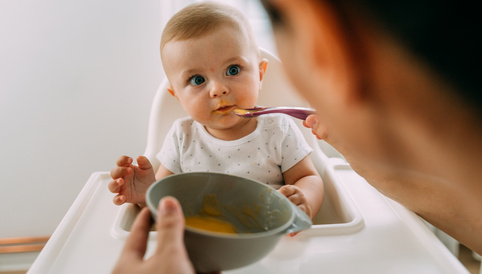
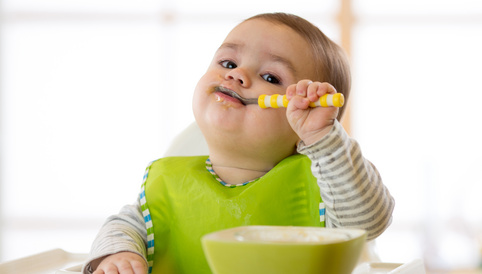
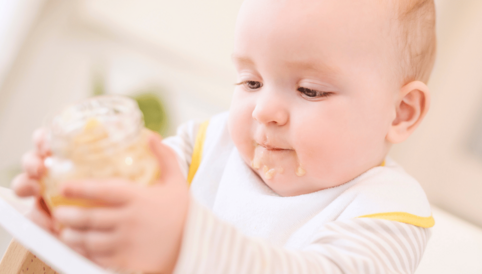
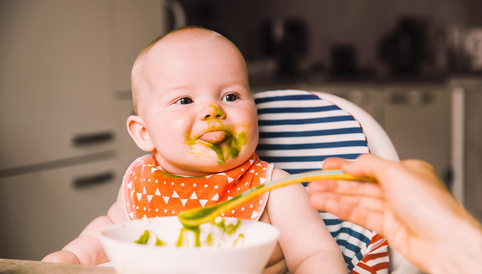
The term “solid foods” refers to all foods given to infants other than breast milk or infant formula. In principle, introducing solid foods involves a gradual transition from liquid formula to pureed foods and eventually to eating at the family table.
You should start introducing solid foods no earlier than the 5th month and no later than the beginning of the 7th month. You can tell if your child is ready for their first porridge by, among other things, whether they show interest in the food on the table, can sit upright, or are often still hungry after a milk feeding. For more tips on starting solid foods, read on here.
-
Phase 3: Introduction of Family MealsEating Together at the Family Table
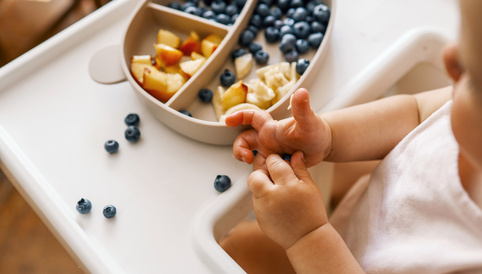
Starting around the 10th month, you can slowly start teaching your baby to eat with the family at the table. Please note that your little foodie cannot yet eat small, hard foods, such as nuts. There is a risk of choking. Foods that are too sweet, greasy, or spicy are also unsuitable for your child’s still-sensitive digestive system.
You decide when and how to introduce solid foods.
Whether your baby tries their first spoonfuls of homemade food or food from a jar, or whether you let your baby set the pace entirely on their own with “baby-led weaning,” the choice is yours. The important thing to remember is that, by 6 months at the latest, breast milk or formula alone is no longer enough to meet your baby’s nutritional needs. We hope you have fun - and plenty of patience - as you introduce solid foods.



Our experts at Alete Family Services are here for you.
If you have questions about nutrition during the weaning stage or about our products, our experienced colleagues at Alete Family Service will be happy to offer you advice and assistance.
Monday through Friday: 9:00 a.m. to 2:00 p.m.
Phone: 0800-1125205
Email: info@alete.de